 YardTime
Support
Privacy
YardTime
Support
Privacy
Why we built it
It started as a fix for one fence line, and we've tried hard not to let it become anything more than that.
The fence
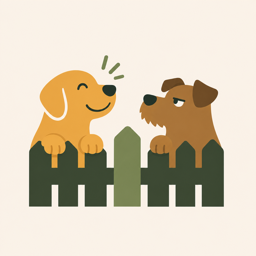
Two dogs, one shared fence. Separately, both of them are delightful. Together, through chain link, they are a neighborhood event — the kind where you end up outside in a bathrobe at 6am apologizing to someone you otherwise like very much.
The fix is obvious the first time you think of it: take turns. Nobody's dog has to be out at the same time as anybody else's. The problem is that taking turns requires knowing, and you can't see over the fence. So you text. Then you text again. Then someone renames the group chat to "dog" when their dog is out, and back again when he's in, and this works for about a week — until somebody forgets to change it back and everyone spends a day and a half believing the yard is occupied.
That's the entire origin story. YardTime is the group-chat-photo trick, made into something that can't be forgotten: one tap says the yard is taken, a timer gives it back automatically, and everyone hears the moment it's clear.
What we deliberately didn't build
Most of the work has been in what got left out.
No accounts. There's no YardTime login, no password, no email sign-up. It rides on the Apple Account already signed in on your iPhone. An app you use four times a day for eight seconds should not have a password.
No servers. Your group's data lives in your iCloud account and is shared with your neighbors through Apple's CloudKit. We don't operate a database, so there's no admin panel, no credentials, nothing to breach, and no way for us to read your yard status — a promise that holds because of how it's built, not because of how nice we are. The privacy policy goes clause by clause.
No analytics. The app has no telemetry SDK of any kind. We genuinely do not know how many people use YardTime or which buttons they press. This is occasionally inconvenient for us and exactly right for you.
No feed, no profiles, no neighborhood social network. The world has enough places for neighbors to argue. This one has a status and a timer.
No location. YardTime never asks for it and never uses GPS. It's not a pet tracker and it doesn't know where your house is. Whether the yard is taken is not a location question.
Why it's free
There are no ads, no subscription, no paid tier, and nothing sold — including your data, which we couldn't sell if we wanted to, because we don't have it.
An app that only works when your neighbors also install it is an app that can't afford a price tag. Every dollar of friction between you and the person on the other side of the fence is a reason the whole thing stays broken. So it's free, and it's staying that way.
It does cost something to keep on the store, though. If YardTime brought peace to your fence line and you feel like saying thanks, you can ☕ buy us a coffee. It goes to the Apple developer fee and the occasional bag of treats for the resident QA department.
Where it goes next
It's still a small app made for a small problem, and the roadmap is mostly whatever the people using it ask for. So far that's how the widgets, the Apple Watch app, and the NFC tap tags all happened — somebody said "I wish I didn't have to open the app," three times, in three different ways. Planning yard time ahead came the same way: "I wish they knew I wanted the yard at 7:30." It stays a heads-up rather than a booking system, because the fence line runs on trust, not enforcement.
If you've got a fence-line problem we haven't solved yet, tell us: [email protected]. And if a neighbor of yours has just sent you an invite, start here.
Two dogs. One fence. Zero standoffs.

Free · no account · 🐾 nothing tracked